
Any headline that ends in a question mark can be answered by the word no.
— Betteridge's Law of Headlines
Too much and never enough
In a world where content reigns supreme, your focus—your attention!—has become your most starved resource.
Before screens, your attention was inlaid on what was in front of you: food, dreams, ambition, morality. Relationships demand attention. Brands covet it. Attention exists as a function of time; both limited and ever-draining.
Gutenberg's printing press brought information to the masses. Where knowledge was once hidden, once gated, the layman could now learn about the absurdity of the world, access great ideas only previously conjured by the deepest philosophers, all without leaving their home. Walled gardens collapsed as information became commonplace. The internet took it a step further and made esoteric knowledge available to anyone who cared to look.
As media became easier to access, the bottlenecks shifted. We are no longer constrained by knowledge: there are now more videos uploaded in a day than you can watch in a year and more books than anyone can read in a hundred lifetimes.
Technology obeyed the law of equivalent exchange—and the price was attention. The constraint is no longer what you can find. It is what you can afford to notice, and with it, your sense of what's worth caring about.
Your attention shapes you. Lawrence Yao writes about the omnipresence of work bleeding into personal life: what smartphones give us in convenience they take from our soul. Work and leisure used to cleanly delineate; you reclaimed your time, your attention once you were home. But now, the handheld window to another world has become a leash, calling your name, beckoning, ever-present in the moment. With phones, you're always on call—you simply choose whether you have the attention to listen.
TikTok-ification
Stranger Things (2016-2025), once lauded as a candidate for the best television series of all time, ended on a sour note. The production quality of its fifth season declined noticeably, with the sterile 2020s studio lighting and the flat visuals it birthed, and pacing all over the place, a symptom of the producers prioritizing scenes that could be cut to create viral moments that can be ceaselessly reposted online. Compare the two intro sequences of Devil Wears Prada (2006) and Devil Wears Prada 2 (2026): actively revised so it fits in 9:16, because the intended viewer is a phone-scroller.
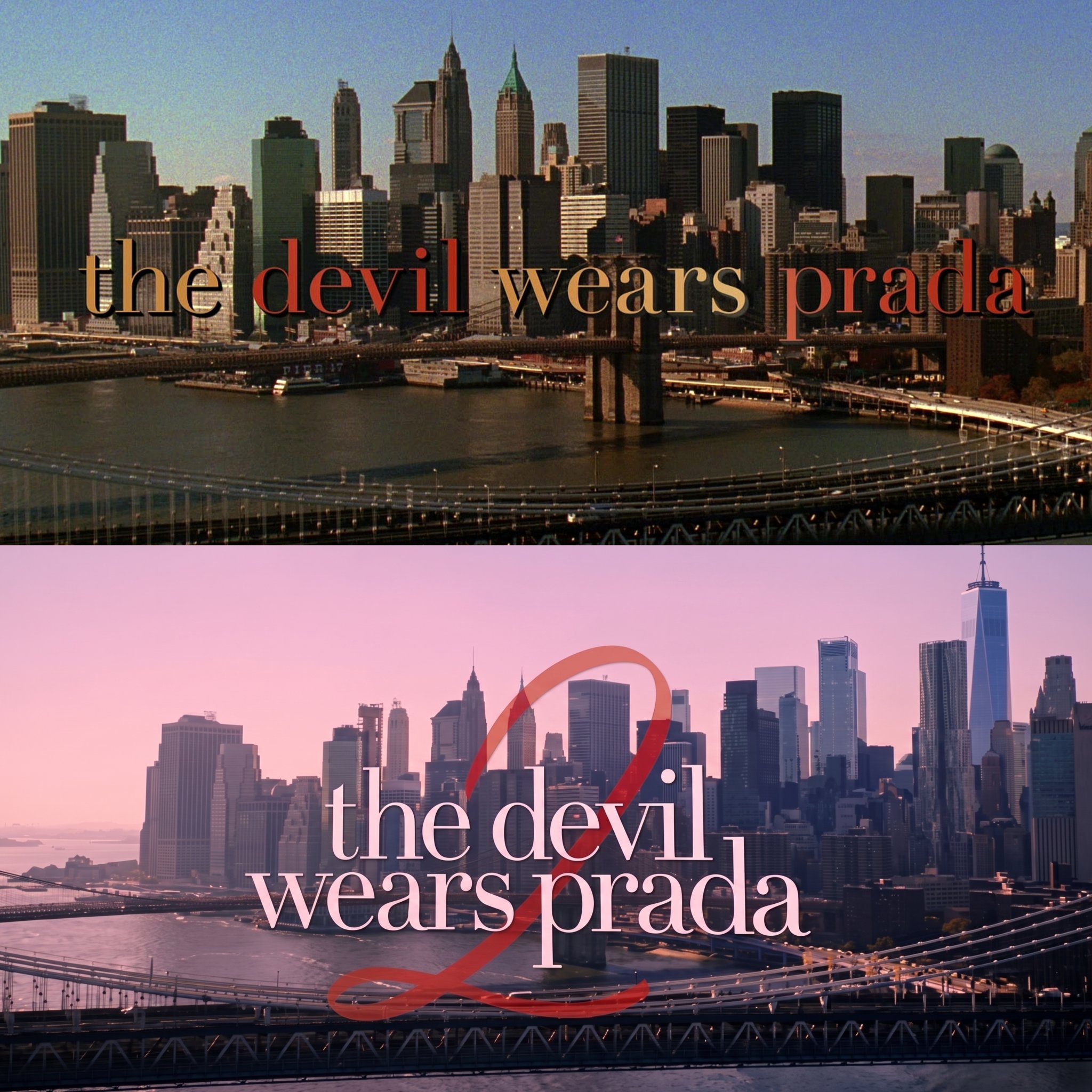
Twenty years apart, the original title spans the full width of the screen, whereas the sequel stacks the title neatly into two lines for conversion into a vertical viewing format
As my friend Grace Kasten notes succinctly, media is converging into smaller and denser formats. As streaming bandwidth improved, text became photo became video. Platforms have quickly adapted to the change, from Twitter to Instagram to TikTok. Long-form art compresses into quickly consumable content from books to essays to tweets and the same in how we've gone from theatres to YouTube to Reels.
Films like Stanley Kubrick's 2001: A Space Odyssey (1968), Quentin Tarantino's Hateful Eight (2015), and Banshees of Inisherin (2022) have long scenes of silence and controlled pacing to induce tension between its characters. But modern audiences hastily skip ahead, unwilling to wait for slow expositions and the deliberate, lingering takes that carry the heaviest narrative work.
When content is condensed into funny moments and short clips, viewers lose all nuance and subtlety from the original. Character development no longer has a place because they can't meaningfully change in three minutes of dialogue; audiences no longer understand insinuation or implication and need things explicitly stated. Attention spans continue to shrink.
To be heard in an algorithmic world, you must be loud.
Attention economy
We die twice: once when we draw our last breath, again when we cease to be remembered.
Celebrities like Kanye, Kim K, Paris Hilton, Destiny, and the Paul brothers thirst for a fleeting gaze, to be recognized, to be remembered. Donald Trump is the most notable exemplar, a longtime model and television show host before his foray into politics. Their greatest fear is to fall out of relevance. They understand this is an inescapable fate, one that can be softened by curating a legacy, yet time again and since time immemorial they choose to live on in infamy instead of resting as legends.
In the modern age, we live in the moment. Billionaires with nothing better to do are eager to tout their spaceships to Mars and performative donations to African mosquito nets. Gone are the ages of philanthropy and charity. Bezos and Altman will die with little to preserve their memory while our permanent institutions that serve the public will still have Carnegie and Rockefeller written on them.
Venture-backed validation-seeking
Chungus Lee and his clout-chasing Cluely culture have infected San Francisco. The need for startups to revel in the public eye and the a16z1 ethos to fund direct competitors (as opposed to kingmakers like Sequoia and Khosla) means that the attention economy is now seen in a new, positive light: all press is good press. Certainly, Cluely has generated plenty of hype, like hiring office strippers to mask its dismal financials.
The trend has spawned followers like Friend dot com, publicizing their domain spend ($1.8 million on their seed raise of only $2.5 million) to manufacture a response. Sperm Racing2 wants to host a FIFA-esque world cup this year for... well, take a guess. Bryan Johnson's claim that his girlfriend is in the "Top 1% of all vaginas" is a sentence you couldn't beat out of Guantánamo Bay prisoners.
Y Combinator has become Kidz Bop for startups. Portfolio companies across all sorts of funds close a deal (oftentimes with another startup in the same batch), multiply that number by 52x, and brag about their massive ARR3 on X, the everything app. Kids regale feeds with "I just got personally handpicked to attend YC Startup School" and farm engagement, hoping to be noticed. To be seen.
Because attention is now the scarcest resource, it has replaced actual capital and product-market fit as the currency of Silicon Valley. Every raise, every tweet is a scream for validation. Virality slop, viral in the basal sense of the word, has permeated through the web, each newfangled engagement bait competing for a sliver of your attention. It is gauche, crass, uncouth beyond reason. In the pursuit of more, the unending pursuit of that which never ends, we fall into a void that cannot be filled.
Hubris is for hylics
To be a hylic is to be bound to the material world, incapable of seeing beyond the present moment: a dilettante. The prideful chase for worldly recognition is for people who can only see the material world at its surface.
Brands crave your attention, vying for a place in your mind4. They feast on your hunger for status and desire for identity: aspects of material permanence.
The walls of our material world are closing tighter. Virtual reality initially failed to take off because 30-70% of users naturally experience dizziness. But with the cost of inference steadily decreasing and better hardware finding its way into the market, generative AI is poised to produce inescapable, hyper-customized content for all users; I surmise we will see a surge in immersive media formats like augmented reality that can be accessed anywhere at a moment's notice in the coming years. Imagine the overwhelming sensory overload of a teamLab exhibition brought to your bedroom.
New-age personal AI apps like Poke and Avec want to help you reclaim your attention. Devices like Mira, Sabi, and Neuralink aim to extend human context beyond what our minds naturally hold. I'm bullish on human/brain-computer interfaces freeing up what apps cannot and becoming integral to everyday life, such that we won't be able to imagine life without them. But recognize that even if we allow machines to curate our lives, we must still be able to think without them.
So please, appreciate the scarcity of your attention. Relish ephemerality and finitude. Invest in eternal treasures, in things with lasting value, like relationships, not earthly possessions prey to moth and rust and the whims of a recommendation engine.
Exercise discretion. Form your own opinions—it's one of the luxuries nobody can take away from you.
In a world filled with so much to do and so much to see, attention is all you have.
ky
Footnotes
-
Fun fact: Databricks accounts for 23% of their total Net Asset Value (NAV) in their ~$90B portfolio. ↩
-
Which doesn't even race sperm! They've publicly admitted the entire race is a CGI sham; and the actual race, if real, is basically a salt gradient. ↩
-
Annual recurring revenue is a metric intended to measure revenues normalized over a year. The network effect is quite fascinating, as oftentimes these portcos do benefit greatly from services they sell to each other; conversely, we see defunct failures like Ghostship (S25) propped up by a circlejerk leading to vastly inflated valuations for everyone else in the batch. ↩
-
Ads Don't Work That Way by Kevin Simler argues advertising's real mechanism isn't persuasion, but cultural imprinting. Ads work by making you confident that everyone else has seen them too. A brand doubles as a piece of common knowledge you can wield socially. The value of a Patagonia vest isn't in what you know about it; it's in your certainty that others know it too. And attention is the substrate that common knowledge is built on. ↩