
On the traditional geopolitical stage, the Kingdom of Morocco is often overlooked. But beneath scorching Saharan sands lies the lever that moves the global food supply.
Mitochondria is the powerhouse of the cell
In the early prehistoric era, algal blooms were a harbinger of mass extinction: they caused widespread anoxia (oxygen depletion) in the ocean, killing off the majority of marine life each time. In the period of time after, life would bloom once again as the algae died and decomposed. During decomposition, marine algae undergo a process called phosphogenesis, where phosphate from their bodies is rendered into sedimentary apatite as it settles on the ocean floor.
Phosphate is a key nutrient for plant growth—in fact, all life on our planet requires it to build a phospholipid cell membrane, and most rely on it to convert stored energy via aerobic1 respiration.
OCP Group
Naturally occurring phosphorus is exceedingly scarce. Phosphorus typically constitutes between 0.0005% to 0.15% of the earth's crust. In most forms, it is difficult to extract, and the majority of usable2 phosphorus exists in the form of apatite.
The Office Chérifien3 des Phosphates (OCP Group) is the world's largest producer of phosphate rock. As a state-owned monopoly, OCP accounts for over 30% of global phosphate production and is also the largest fertilizer manufacturer in the world. 10% of Morocco's GDP and 20% of Moroccan exports can be attributed directly to phosphate mining.
The distribution of phosphorus in the crust is extremely concentrated—Morocco retains the vast majority of marine placer deposits in the form of mineral sands, and controls more than 70% of the world's phosphate reserves. China, Algeria, and Syria trail with single-digit percentages.
Western Sahara
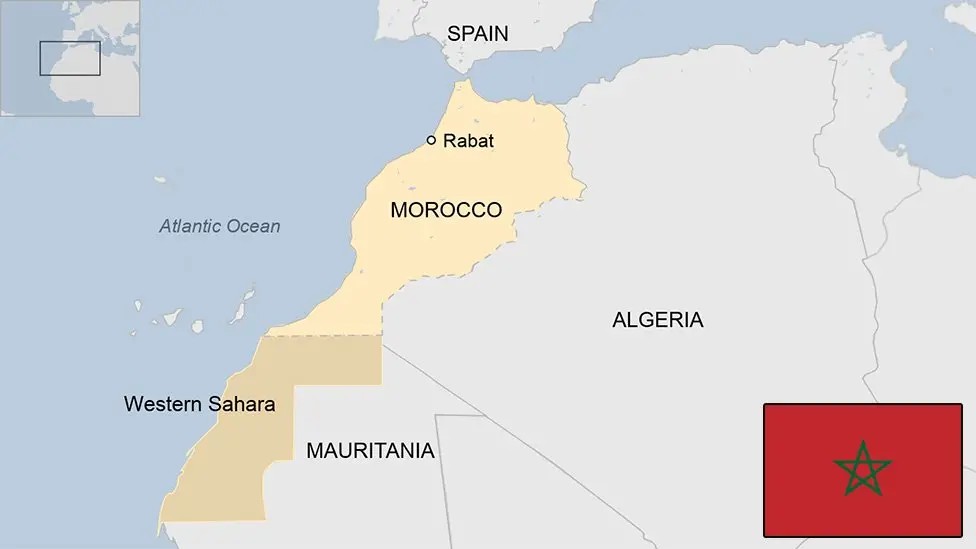
The Maghreb (Far West) region of North Africa houses the disputed territory known as Western Sahara. Formerly known as the Spanish colony of Provincia del Sahara, Western Sahara is a desolate desert bordered by Morocco to the north, Mauritania to the south, Algeria to the east, and the Atlantic Ocean to the west.
In the barren sands of the Western Sahara, a sixty mile long conveyor belt connects the mining site Bou Craa to the port city El Marsa. Visible from space, the belt is a testament to the scale of Greater Morocco's phosphate industry. As a free state, Western Sahara would contain the second largest phosphate reserves in the world.
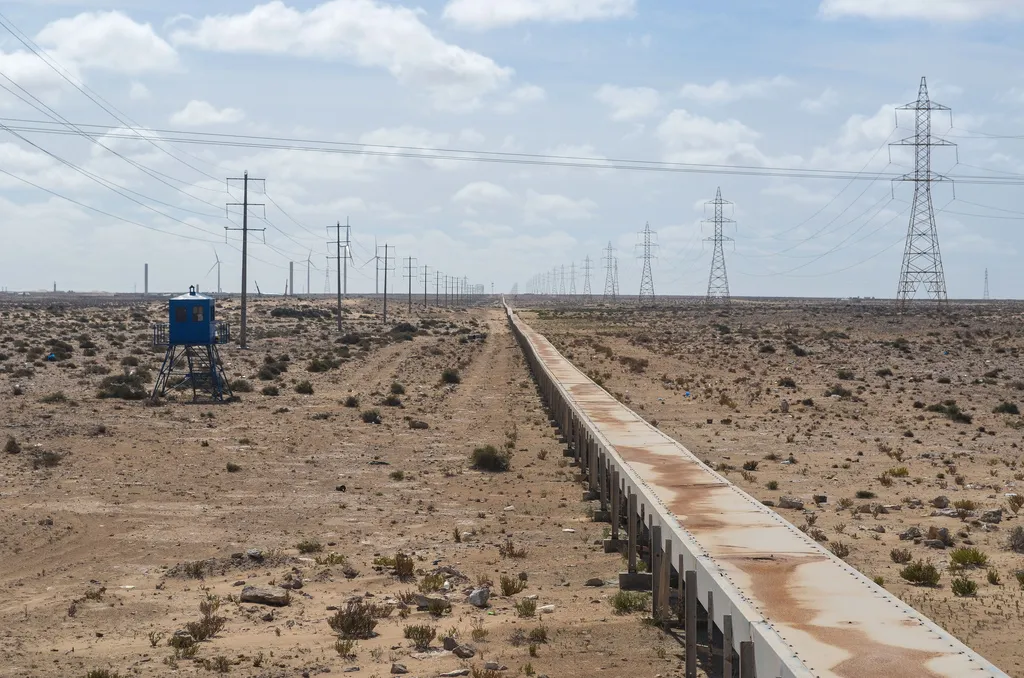 Across the empty expanse of the Sahara stretches a solitary stone-laden stripe
As Spain withdrew following the Madrid Accords of 1975, Morocco effectively annexed the territory. Today, OCP acts as the vanguard of Moroccan colonialism in the region. By controlling and extracting Western Sahara's resources, OCP Group economically exercises Morocco's territorial claim and profits from massive mining complexes guarded by military deployments.
Reserves vs. Resources
In 2018, Norge Mining discovered a ~70 billion ton deposit of phosphate in Sokndal of southwestern Norway. However, there's a crucial difference between that massive deposit and Moroccan sands: the Sokndal deposit rests 2.7 miles below the surface.
Pride and Phosphorus
Crop rotation allowed farmers in ancient civilizations to maintain soil fertility for thousands of years, but harvesting crops depletes the soil of essential nutrients including phosphorus and nitrogen. History is rife with the corpses of empires that failed to understand soil chemistry. Ancient Mesopotamia, the cradle of civilization, met its end by desertification. Extensive irrigation in arid climates causes water evaporation. Upstream sources contain trace amounts of salt, inconsequential in decades but deep poison over centuries. Salt turned the Fertile Crescent barren.
For millennia, Asian farmers have been able to avoid the shared fate of central Eurasian civilizations with wet-rice agriculture. The standing water in rice paddies regulates temperatures and prevents salt accumulation, while cyanobacteria thriving in the water naturally fix nitrogen from the air.
However, even the most brilliant among us cannot make something from nothing. Harvesting rice still extracts phosphorus from a closed loop. Phosphate does not replenish itself naturally outside of cyclical biological sources like poop/guano, and is thus necessarily a key ingredient in industrial fertilizer.
To sustain the massive yields required by modern global populations, the paddies of East Asia are reliant on external inputs of industrial phosphate. Morocco accounts for ~30% of the Asian phosphate market. China, the only other major supplier in the region, exercises a strict export quota. As it stands, Morocco is slated to stay the dominant supplier of industrial phosphate for the global market.
Unlike biofuels (bioethanol), synthetic replacements for phosphorus do not exist. The USGS puts it concisely: There are no substitutes for phosphorus in agriculture.
If OCP Group were to halt exports tomorrow, the resulting fertilizer shortage would cause a global famine. It is through this power that Morocco can force the world to turn a blind eye to the military occupation of Western Sahara. Yet ironically, Morocco can only remain dominant so long as it remains subservient. When the entire economy is built around a single commodity, diversification is an afterthought. Morocco is relegated to extracting raw materials, servant to the world's true empires, never a hegemon, forever in the periphery—an afterthought of its own making.
ky
Footnotes
-
The P in ATP stands for phosphate. ↩
-
The ocean is actually saturated with phosphorus, but it is not uniformly distributed. There is roughly 30x more phosphorus in deep ocean compared to warm waters. Upwelling occasionally brings large amounts of it to the surface, causing algal blooms. ↩
-
Chérifien = Sharifian. Astute readers may notice that the Sharifian Caliphate did not span Morocco at its peak—the term Sharifian refers to the Saadi Sultanate, which claimed noble descent from the Prophet Muhammad in the same way Chinese dynasties claimed the Mandate of Heaven. ↩